What's in it?
Search Entire CPID Database
Enter Products, Manufacturers, Chemicals, Product Categories and Product Types
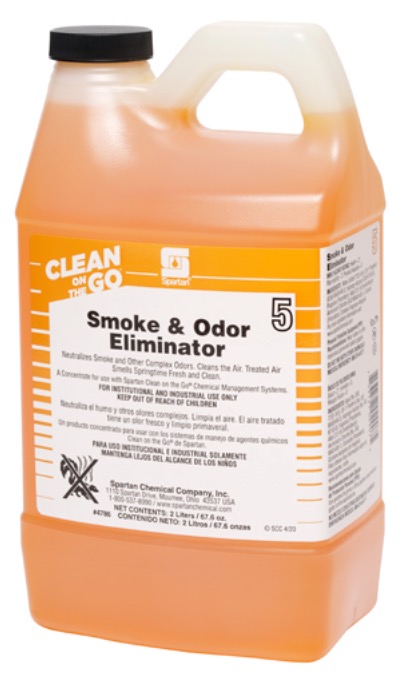 |
Spartan Smoke & Odor Eliminator 5, Clean On The Go, Fresh Scent, 478602-04/06/2020
Products in this Consumer Product Information Database (CPID) are classified based on their composition:
Substances: single chemicals
Preparations: products which contain chemicals that can be easily separated during normal use
Articles: products or product assemblies that do not contain chemicals that can be separated out from the product or assembly under normal or advertised use.
Classification: Preparation
Indicates country where product is sold.
Market: US/CanadaSpartan Smoke & Odor Eliminator 5 with its earthy scent with hints of leather and pine, is a water-soluble air freshener formulated to eliminate unpleasant odors. While regularly scheduled cleaning and disinfecting procedures eliminate the soils and bacteria which cause most odors; people, pets, food, and accidents cause malodors which permeate surfaces, making the air unpleasant..
Purpose of product.
Usage: Air freshenerStructure such as solid, liquid, aerosol etc.
Form: liquidDate when validity of Material Safety Data Sheet (MSDS) or Safety Data Sheet (SDS) was last verified.
Date verified: April 24, 20251110 Spartan Dr
Maumee OH 43537
-
Chemical Composition/Ingredients
The GHS is an acronym for The Globally Harmonized System of Classification and Labelling of Chemicals. The GHS is a system for standardizing and harmonizing the classification and labelling of chemicals. Chemicals are associated with codes that define their health, physical and environmental hazards.This universal hazard communication system was developed to ensure that employers, employees and consumers are provided with adequate, practical, reliable and comprehensible information on the hazards of chemicals, so that they can take effective preventive and protective measure for their own health and safety.
Advanced
The GHS classifications for chemicals associated with products in this database may be viewed by selecting the "Advanced" button on the Chemical Ingredients tables. Since this is a work in progress, GHS classifications may not be shown for all chemical ingredients.-
Primary Chemical Name is the standard name assigned to a chemical substance.
ChemicalChemical Abstracts Service Registry Number is a unique identifier for a chemical and its synonyms. CAS numbers identify the chemical, but not its concentration or specific mixture. CAS Registry Numbers are assigned by the Chemical Abstracts Service, a division of the American Chemical Society. For more information: www.cas.org
CAS No./ID
We have assigned "ID numbers" (with 6 leading zeros or nines, e.g., 000000-xx-x , 888888-xx-x) or 999999-xx-x) for blends and chemicals that do not have CAS numbers.Percent of chemical in preparation.
% Conc.Purpose served by this chemical
FunctionChemical of Concern (CoC)
Chemical of Concern(CoC)Water 007732-18-5 30.0-60.0 Diluent No C9-11 Pareth-3 068439-46-3 10.0-30.0 Surfactant No Isopropanol 000067-63-0 10.0-30.0 Solvent Yes  CoC List
Fragrance(s)/perfume(s) 000000-00-1 3.0-7.0 Withheld as CBI No Alkyl(C12-16)dimethylbenzylammonium chloride 068424-85-1 1.0-5.0 Surfactant Yes CoC List
Phenylethyl alcohol 000060-12-8 1.0-5.0 Fragrance No Linalool 000078-70-6 1.0-5.0 Fragrance Yes CoC List
Cyclohexanol, 4-(1-Methylethyl)- 004621-04-9 1.0-5.0 Fragrance No Citronellol 000106-22-9 1.0-5.0 Fragrance Yes CoC List
Benzyl alcohol 000100-51-6 1.0-5.0 Fragrance Yes CoC List
Benzyl acetate 000140-11-4 1.0-5.0 Fragrance No 2-T-Butylcyclohexyl Acetate 000088-41-5 1.0-5.0 Fragrance No Hexamethylindanopyran 001222-05-5 0.1-1.0 Fragrance Yes CoC List
Dimethylcyclohex-3-ene-1-carbaldehyde 068737-61-1 0.1-1.0 Fragrance No 1,1-Dimethoxy-2-phenylethane 000101-48-4 0.1-1.0 Fragrance No Methyl Phenylbutanol 000103-05-9 0.1-1.0 Fragrance No Hexahydro-Methanoindenyl Propionate 068912-13-0 0.1-1.0 Fragrance No Geraniol 000106-24-1 0.1-1.0 Fragrance Yes CoC List
Amyl Cinnamal 000122-40-7 0.1-1.0 Fragrance Yes CoC List
Allyl Cyclohexylpropionate 002705-87-5 0.1-1.0 Fragrance No C.I. Acid Yellow 000587-98-4 <0.1 Colorant No -
Health Effects Information
Ingredients and Health Effects Information are taken from the manufacturer's product label and/or the Safety Data Sheet (SDS). Products are not tested and manufacturer's information presented here is not evaluated by DeLima Associates.
View Safety Data Sheet(SDS) Date that the Safety Data Sheet (SDS) was issued by manufacturer of a specific product.
SDS DATE :April 06, 2020 Health Flammability Reactivity HMIS is the Hazardous Materials Identification System developed by the American Coatings Association and indicates the levels (“1” to “4”) of Health Hazard, Flammability Hazard and Physical Hazard associated with a specific product.
HMIS RATING2* 3 0 Measure of Alkalinity/Acidity of substance or preparation where a level of 7 is considered as neutral.
pH Levels6.0-7.0 -
Warnings
Hazard Statements
Danger. Causes serious eye damage. Causes skin irritation. May cause an allergic skin reaction. Flammable liquid and vapor. May be harmful if swallowed. Inhalation of vapors or mist may cause respiratory irritation.
Precautionary Statements
General
None.
Prevention
Avoid breathing dust/fume/gas/mist/vapors/spray. Contaminated work clothing must not be allowed out of the workplace. Keep away from heat, hot surfaces, sparks, open flames and other ignition sources. No smoking. Keep container tightly closed. Ground and bond container and receiving equipment. Use explosion-proof electrical, ventilating and lighting equipment. Use non-sparking tools. Take action to prevent static discharges. Wear protective gloves/clothing and eye/face protection. Wash face, hands and any exposed skin thoroughly after handling.
Response
IF IN EYES: Rinse cautiously with water for several minutes. Remove contact lenses, if present and easy to do. Continue rinsing. Immediately call a POISON CENTER or doctor.
IF ON SKIN (or hair): Take off immediately all contaminated clothing. Rinse skin with water [or shower]. If skin irritation or rash occurs: Get medical advice/attention. Wash contaminated clothing before reuse.
Fire: In case of fire: Use CO2, dry chemical, or foam for extinction
Storage
Store in a well-ventilated place. Keep cool.
Disposal
Dispose of contents and container in accordance with local, state and federal regulations. -
Acute health effects
From SDS:
Hazards Identification
Emergency Overview
Danger. Causes serious eye damage. Causes skin irritation. May cause an allergic skin reaction. Flammable liquid and vapor. May be harmful if swallowed. Inhalation of vapors or mist may cause respiratory irritation.
Potential Health Effects
Eye Contact: Pain, redness, swelling of the conjunctiva and tissue damage. Eye contact may cause permanent damage.
Skin Contact: Pain, redness and cracking of the skin. May cause sensitization by skin contact.
Inhalation: Nasal discomfort and coughing.
Ingestion: Pain, nausea, vomiting and diarrhea. Ingestion may cause irritation to mucous membranes. -
Chronic health effects
From SDS:
No information. -
Carcinogenicity
No components present at 0.1% or greater are listed as to being carcinogens by ACGIH, IARC, NTP or OSHA.
-
Handling information
Handle in accordance with good industrial hygiene and safety practice. Wash thoroughly after handling. Keep container tightly closed in a dry and well-ventilated place. Keep out of the reach of children. Keep from freezing. -
Disposal information
Dispose of in accordance with federal, state and local regulations. Pressurized container: Do not pierce or burn, even after use. -
California Prop. 65 Warning
This product is not subject to warning requirements under California Proposition 65.
-
First Aid
Eye Contact: Rinse cautiously with water for several minutes. Remove contact lenses, if present and easy to do. Continue rinsing. If eye irritation persists: Get medical attention.Skin Contact: Wash with soap and water. If skin irritation occurs: Get medical attention. Wash contaminated clothing before reuse.Inhalation: Remove victim to fresh air and keep at rest in a position comfortable for breathing. Call a poison control center or physician if you feel unwell.Ingestion: Rinse mouth. Do NOT induce vomiting. Never give anything by mouth to an unconscious person. Get medical attention if you feel unwell.
-

 UN Global Harmonization Classification


