What's in it?
Search Entire CPID Database
Enter Products, Manufacturers, Chemicals, Product Categories and Product Types
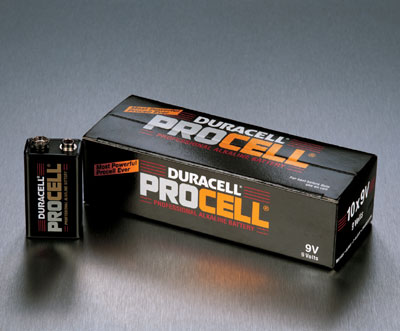 |
Duracell Procell Lithium 9-Volt Battery
Products in this Consumer Product Information Database (CPID) are classified based on their composition:
Substances: single chemicals
Preparations: products which contain chemicals that can be easily separated during normal use
Articles: products or product assemblies that do not contain chemicals that can be separated out from the product or assembly under normal or advertised use.
Classification: Preparation
Indicates country where product is sold.
Market: US/CanadaPurpose of product.
Usage: Lithium BatteryStructure such as solid, liquid, aerosol etc.
Form: solidDate when validity of Material Safety Data Sheet (MSDS) or Safety Data Sheet (SDS) was last verified.
Date verified: April 24, 2025P.O. Box 599
Cincinnati OH 45201
-
Chemical Composition/Ingredients
The GHS is an acronym for The Globally Harmonized System of Classification and Labelling of Chemicals. The GHS is a system for standardizing and harmonizing the classification and labelling of chemicals. Chemicals are associated with codes that define their health, physical and environmental hazards.This universal hazard communication system was developed to ensure that employers, employees and consumers are provided with adequate, practical, reliable and comprehensible information on the hazards of chemicals, so that they can take effective preventive and protective measure for their own health and safety.
Back
The GHS classifications for chemicals associated with products in this database may be viewed by selecting the "Advanced" button on the Chemical Ingredients tables. Since this is a work in progress, GHS classifications may not be shown for all chemical ingredients.-
Primary Chemical Name is the standard name assigned to a chemical substance.
ChemicalChemical Abstracts Service Registry Number is a unique identifier for a chemical and its synonyms. CAS numbers identify the chemical, but not its concentration or specific mixture. CAS Registry Numbers are assigned by the Chemical Abstracts Service, a division of the American Chemical Society. For more information: www.cas.org
CAS No./ID
We have assigned "ID numbers" (with 6 leading zeros or nines, e.g., 000000-xx-x , 888888-xx-x) or 999999-xx-x) for blends and chemicals that do not have CAS numbers.Is a seven-digit number (xxx-xxx-x) assigned by the European Commission to chemicals contained in three inventories:
EC No.
EINECS is the European Inventory of Existing Commercial Substances and its EINECS numbers are displayed as 2xx-xxx-x.
ELINCS is the European List of Notified Chemical Substances that was available after September 18, 1981 and its ELINCS numbers are displayed as 4xx-xxx-x.
NLP is the No-Longer Polymers category and its NLP numbers are displayed as 5xx-xxx-xPercent of chemical in preparation.
% Conc.California Prop.65 Chemical?The GHS is an acronym for The Globally Harmonized System of Classification and Labelling of Chemicals. The GHS is a system for standardizing and harmonizing the classification and labelling of chemicals. Chemicals are associated with codes that define their health, physical and environmental hazards.This universal hazard communication system was developed to ensure that employers, employees and consumers are provided with adequate, practical, reliable and comprehensible information on the hazards of chemicals, so that they can take effective preventive and protective measure for their own health and safety.
The GHS classifications for chemicals associated with products in this database may be viewed by selecting the "Advanced" button on the Chemical Ingredients tables. Since this is a work in progress, GHS classifications may not be shown for all chemical ingredients. UN Global Harmonization Classification
Hazard Codes and their associated descriptions are an essential part of the Globally Harmonized System of Classification and Labelling of Chemicals (GHS). There are 4 categories of Hazard Codes:
- Physical Hazard Codes (H200 series)
- Health Hazard Codes (H300 series)
- Environmental Hazard Codes (H400 series)
- Supplementary Hazard Codes (EUH series)
Hazard Codes may be found in the "Advanced" version of Chemical Composition / Ingredients tables.
Hazard Statement CodePrecautionary Codes and their associated descriptions are an essential part of the Globally Harmonized System of Classification and Labelling of Chemicals (GHS).
Precautionary Code
Precautionary Codes may be found in the "Advanced" version of Chemical Composition / Ingredients tables.PictogramSVHC is a substance (identified by the European Chemicals Agency) that may have serious and often irreversible effects on human health and the environment. SVHC are defined in Article 57 of Regulation (EC) No 1907/2006 (“the REACH Regulation”) and include substances which are:
SVHC?
1. Carcinogenic, Mutagenic or toxic to Reproduction (CMR), meeting the criteria for classification in category 1 or 2 in accordance with Directive 67/548/EEC or in category 1a or 1b in accordance with EC No 1272/2008This directive was recently replaced by the new EU regulation (EC) No 1272/2008.
2. Persistent, Bioaccumulative and Toxic (PBT) or very Persistent and very Bioaccumulative (vPvB) according to the criteria in Annex XIII of the REACH Regulation, or
3. Identified, on a case-by-case basis, from scientific evidence as causing probable serious effects to human health or the environment of an equivalent level of concern as those above (e.g. endocrine disrupters).Endocrine Disruptor (ED)Manganese Dioxide
001313-13-9
215-202-633-36 No H373, H332, H302, EUH031 P271, P261, P264, P270, P260 


No No 1,2-Dimethoxyethane
000110-71-4
203-794-96.4-7.4 No H225, H360, H332, EUH019 -- 

Yes No Propylene carbonate
000108-32-7
203-572-12.9-4.5 No H319 P264, P280, P305+P351+P338, P337+P313 No No Lithium
007439-93-2
231-102-52.5-3.5 No H260, H314, EUH014 -- 
No No Ethylene carbonate
000096-49-1
202-510-01.9-3.3 No H319, H373, H302 P264, P280, P305+P351+P338, P337+P313 No No Lithium trifluoromethanesulfonate
033454-82-9
251-528-51.6-2.7 No H319, H302 P264, P270, P301+P312, P330, P501, P280, P305+P351+P338, P337+P313 No No -
-
Hazard Statements
-
- Code
- Statement
- H225 : Highly flammable liquid and vapourH260 : In contact with water releases flammable gases which may ignite spontaneouslyH302 : Harmful if swallowedH314 : Causes severe skin burns and eye damageH319 : Causes serious eye irritationH332 : Harmful if inhaledH360 : May damage fertility or the unborn childH373 : May cause damage to organsEUH014 : Reacts violently with waterEUH019 : May form explosive peroxidesEUH031 : Contact with acids liberates toxic gas
- P260 : Do not breathe dust/fume/gas/mist/vapours/sprayP261 : Avoid breathing dust/fume/gas/mist/vapours/sprayP264 : Wash … thoroughly after handlingP270 : Do not eat, drink or smoke when using this productP271 : Use only outdoors or in a well-ventilated areaP280 : Wear protective gloves/protective clothing/eye protection/face protectionP330 : Rinse mouthP301+P312 : IF SWALLOWED: Call a POISON CENTER or doctor/physician if you feel unwellP305+P351+P338 : IF IN EYES: Rinse continuously with water for several minutes. Remove contact lenses if present and easy to doP337+P313 : Get medical advice/attentionP501 : Dispose of contents/container to
- GHS02 : FlammableGHS05 : CorrosiveGHS07 : IrritantGHS08 : Health Hazard
-
-
Health Effects Information
Ingredients and Health Effects Information are taken from the manufacturer's product label and/or the Material Safety Data Sheet (MSDS). Products are not tested and manufacturer's information presented here is not evaluated by DeLima Associates.
View Material Safety Data Sheet(MSDS) Date that Material Safety Data Sheet (MSDS) or Safety Data Sheet (SDS) was issued by manufacturer of product.
MSDS DATE :April 04, 2005 Date when validity of Material Safety Data Sheet (MSDS) or Safety Data Sheet (SDS) was last verified.
MSDS Verified :September 03, 2008 Health Flammability Reactivity HMIS is the Hazardous Materials Identification System developed by the American Coatings Association and indicates the levels (“1” to “4”) of Health Hazard, Flammability Hazard and Physical Hazard associated with a specific product.
HMIS RATINGN N N -
SVHC declaration
Warning: This product contains Substances of Very High Concern (SVHC).
-
Warnings
Store at room temperature. Avoid mechanical or electrical abuse. DO NOT short or install incorrectly. Batteries may explode, pyrolize or vent if disassembled, crushed, recharged or exposed to high temperatures. Install batteries in accordance with equipment instructions. Replace all batteries in equipment at the same time. Do not carry batteries loose in pocket or bag. -
Acute health effects
From MSDS:
Routes/Effects of Exposure
These chemicals and metals are contained in a sealed can. For consumer use, adequate hazard warnings are included on both the package and on the battery. Potential for exposure should not exist unless the battery leaks, is exposed to high temperature or is mechanically, physically, or electrically abused.
1. Inhalation: Not anticipated. Respiratory (and eye) irritation may occur if fumes are released due to heat or an abundance of leaking batteries.
2. Ingestion: Irritation to the internal/external mouth area may occur following exposure to a leaking battery.
3. Skin:
a. Contact Irritation may occur following exposure to a leaking battery.
b. Absorption: Not anticipated.
4. Eye Contact: Irritation may occur following exposure to a leaking battery. -
Chronic health effects
From MSDS:
No information provided. -
Carcinogenicity
No information provided. -
Handling information
Store at room temperature. Avoid mechanical or electrical abuse. DO NOT short or install incorrectly. Batteries may explode, pyrolize or vent if disassembled, crushed, recharged or exposed to high temperatures. Install batteries in accordance with equipment instructions. Replace all batteries in equipment at the same time. Do not carry batteries loose in pocket or bag. -
Disposal information
No special precautions are required for small quantities. Large quantities of open batteries should be treated as hazardous waste. Dispose of in accordance with federal, state and local regulations. Do not incinerate, since batteries may explode at excessive temperatures. -
First Aid
Eyes: Not anticipated. If battery is leaking and material contacts eyes, flush with copious amounts of clear, tepid water for 30 minutes. Contact a physician at once.
Skin: Not anticipated. If battery is leaking, irrigate exposed skin with copious amounts of clear, tepid water for at least 15 minutes. If irritation, injury or pain persists, consult a physician.
Inhalation: Not anticipated. If battery is leaking, contents may be irritating to respiratory passages. Remove to fresh air. Contact physician if irritation persists.
Ingestion: Not anticipated. Rinse the mouth and surrounding area with clear, tepid water for at least 15 minutes. Consult a physician immediately for treatment and to rule out involvement of the esophagus and other tissues.
Notes to Physician
1) Potential leakage of dimethoxyethane, propylene carbonate and lithium trifluoromethane sulfonate.
2) Dimethoxyethane rapidly evaporates.
3) Under certain misuse conditions and by abusively opening the battery, exposed lithium can react with water or moisture in the air causing potential thermal burns or fire.
-
-
