What's in it?
Search Entire CPID Database
Enter Products, Manufacturers, Chemicals, Product Categories and Product Types
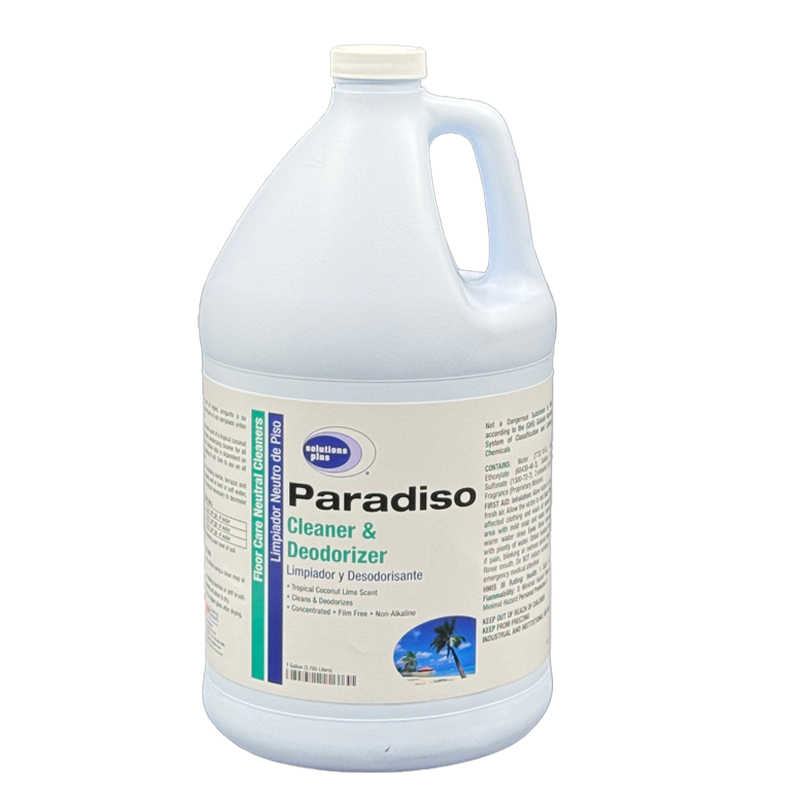 |
Solutions Plus Paradiso Cleaner & Deodorizer, 4813, Professional Use-10/23/2025
Products in this Consumer Product Information Database (CPID) are classified based on their composition:
Substances: single chemicals
Preparations: products which contain chemicals that can be easily separated during normal use
Articles: products or product assemblies that do not contain chemicals that can be separated out from the product or assembly under normal or advertised use.
Classification: Preparation
Indicates country where product is sold.
Market: US/CanadaPurpose of product.
Usage: Multipurpose cleaner and deodorizerStructure such as solid, liquid, aerosol etc.
Form: liquidDate when validity of Material Safety Data Sheet (MSDS) or Safety Data Sheet (SDS) was last verified.
Date verified: April 26, 20253930 Review Avenue
Long Island City NY 11101
-
Chemical Composition/Ingredients
The GHS is an acronym for The Globally Harmonized System of Classification and Labelling of Chemicals. The GHS is a system for standardizing and harmonizing the classification and labelling of chemicals. Chemicals are associated with codes that define their health, physical and environmental hazards.This universal hazard communication system was developed to ensure that employers, employees and consumers are provided with adequate, practical, reliable and comprehensible information on the hazards of chemicals, so that they can take effective preventive and protective measure for their own health and safety.
Advanced
The GHS classifications for chemicals associated with products in this database may be viewed by selecting the "Advanced" button on the Chemical Ingredients tables. Since this is a work in progress, GHS classifications may not be shown for all chemical ingredients.-
Primary Chemical Name is the standard name assigned to a chemical substance.
ChemicalChemical Abstracts Service Registry Number is a unique identifier for a chemical and its synonyms. CAS numbers identify the chemical, but not its concentration or specific mixture. CAS Registry Numbers are assigned by the Chemical Abstracts Service, a division of the American Chemical Society. For more information: www.cas.org
CAS No./ID
We have assigned "ID numbers" (with 6 leading zeros or nines, e.g., 000000-xx-x , 888888-xx-x) or 999999-xx-x) for blends and chemicals that do not have CAS numbers.Percent of chemical in preparation.
% Conc.Purpose served by this chemical
FunctionChemical of Concern (CoC)
Chemical of Concern(CoC)C9-11 Pareth-3 068439-46-3 <2.43 Surfactant No Sodium xylenesulfonate 001300-72-7 1.0-5.0 Surfactant No Water 007732-18-5 -- Diluent No Isopropanol 000067-63-0 -- Surfactant Yes  CoC List
Propylene glycol 000057-55-6 -- Solvent Yes CoC List
Hexamethylindanopyran 001222-05-5 -- Fragrance Yes CoC List
Methyl dihydrojasmonate 024851-98-7 -- Fragrance No Terpenes and Terpenoids, sweet orange-oil 068647-72-3 -- Fragrance No 2,6-Dimethyl-7-Octen-2-Ol 018479-58-8 -- Fragrance No Pentamethylcyclopent-3-Ene-Butanol 065113-99-7 -- Fragrance No Citrus Aurantium Dulcis Oil (Orange oil) 008008-57-9 -- Fragrance No Linalyl acetate 000115-95-7 -- Fragrance No Benzyl Salicylate 000118-58-1 -- Fragrance Yes CoC List
Butylphenyl Methylpropional 000080-54-6 -- Fragrance Yes CoC List
Linalool 000078-70-6 -- Fragrance Yes CoC List
Tetramethyl Acetyloctahydronaphthalenes 054464-57-2 -- Fragrance Yes CoC List
Methylenedioxyphenyl Methylpropanal 001205-17-0 -- Fragrance No Magnesium nitrate 010377-60-3 -- Preservative No Dye(s) (unspecified) 000000-00-2 -- Withheld as CBI No Dye(s) (unspecified) 000000-00-2 -- Withheld as CBI No Methylchloroisothiazoline 026172-55-4 -- Preservative No Methylisothiazoline 002682-20-4 -- Preservative No -
Health Effects Information
Ingredients and Health Effects Information are taken from the manufacturer's product label and/or the Safety Data Sheet (SDS). Products are not tested and manufacturer's information presented here is not evaluated by DeLima Associates.
View Safety Data Sheet(SDS) Date that the Safety Data Sheet (SDS) was issued by manufacturer of a specific product.
SDS DATE :October 23, 2025 Health Flammability Reactivity HMIS is the Hazardous Materials Identification System developed by the American Coatings Association and indicates the levels (“1” to “4”) of Health Hazard, Flammability Hazard and Physical Hazard associated with a specific product.
HMIS RATING1 0 0 Measure of Alkalinity/Acidity of substance or preparation where a level of 7 is considered as neutral.
pH Levels6.0-7.0 -
Warnings
Hazard Statements
Warning. Causes serious eye irritation.
Precautionary Statements
General
None.
Prevention
Wash hands, forearms and face thoroughly after handling. Wear protective gloves, protective clothing, eye protection, face protection, and hearing protection.
Response
If in eyes: Rinse cautiously with water for several minutes. Remove contact lenses, if present and easy to do. Continue rinsing If eye irritation persists: Get medical advice or attention.
Storage
None.
Disposal
None. -
Acute health effects
From SDS:
Hazards Identification
Emergency Overview
Warning. Causes serious eye irritation.
Potential Health Effects
Eye Contact: No information.
Skin Contact: Warning. Causes serious eye irritation.
Inhalation: Not expected to present a significant hazard under anticipated conditions of normal use.
Ingestion: Not expected to present a significant hazard under anticipated conditions of normal use. -
Chronic health effects
From SDS:
None known. -
Carcinogenicity
Not classified.
-
Handling information
Wash hands and other exposed areas with mild soap and water before eating, drinking or smoking and when leaving work. Provide good ventilation in process area to prevent formation of vapor. Contaminated work clothing should not be allowed out of the workplace. Keep only in the original container in a cool, well ventilated place away from heat, hot surfaces, sparks, open flame and other ignition sources. No smoking. Keep container closed when not in use. -
Disposal information
Dispose in a safe manner in accordance with local/national regulations. Avoid release to the environment. -
First Aid
Eye Contact: Rinse immediately with plenty of water. Obtain medical attention if pain, blinking or redness persists.Skin Contact: Remove affected clothing and wash all exposed skin area with mild soap and water, followed by warm water rinse.Inhalation: Allow affected person to breathe fresh air. Allow the victim to rest.Ingestion: Rinse mouth. Do NOT induce vomiting. Obtain emergency medical attention.General: Never give anything by mouth to an unconscious person. If you feel unwell, seek medical advice
-

 UN Global Harmonization Classification


