What's in it?
Search Entire CPID Database
Enter Products, Manufacturers, Chemicals, Product Categories and Product Types
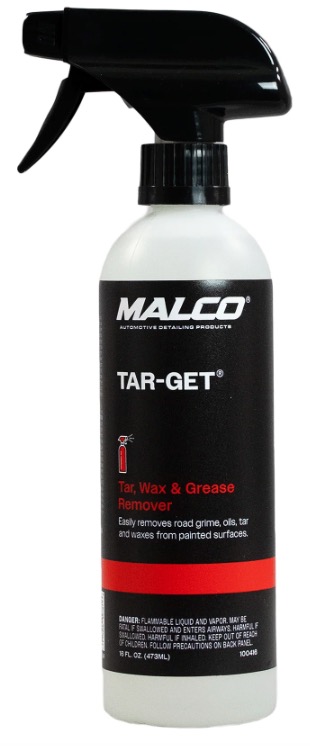 |
Malco Tar-Get Tar, Wax And Grease Remover, 100405, Pump Spray-03/02/2022
Products in this Consumer Product Information Database (CPID) are classified based on their composition:
Substances: single chemicals
Preparations: products which contain chemicals that can be easily separated during normal use
Articles: products or product assemblies that do not contain chemicals that can be separated out from the product or assembly under normal or advertised use.
Classification: Preparation
Indicates country where product is sold.
Market: US/CanadaPurpose of product.
Usage: Tar, Wax And Grease RemoverStructure such as solid, liquid, aerosol etc.
Form: pump sprayDate when validity of Material Safety Data Sheet (MSDS) or Safety Data Sheet (SDS) was last verified.
Date verified: April 21, 2026361 Fairview Avenue
Barberton OH 44203
-
Chemical Composition/Ingredients
The GHS is an acronym for The Globally Harmonized System of Classification and Labelling of Chemicals. The GHS is a system for standardizing and harmonizing the classification and labelling of chemicals. Chemicals are associated with codes that define their health, physical and environmental hazards.This universal hazard communication system was developed to ensure that employers, employees and consumers are provided with adequate, practical, reliable and comprehensible information on the hazards of chemicals, so that they can take effective preventive and protective measure for their own health and safety.
Back
The GHS classifications for chemicals associated with products in this database may be viewed by selecting the "Advanced" button on the Chemical Ingredients tables. Since this is a work in progress, GHS classifications may not be shown for all chemical ingredients.-
Primary Chemical Name is the standard name assigned to a chemical substance.
Chemical Function Purpose served by this chemical.Chemical Abstracts Service Registry Number is a unique identifier for a chemical and its synonyms. CAS numbers identify the chemical, but not its concentration or specific mixture. CAS Registry Numbers are assigned by the Chemical Abstracts Service, a division of the American Chemical Society. For more information: www.cas.org
CAS No./ID
We have assigned "ID numbers" (with 6 leading zeros or nines, e.g., 000000-xx-x , 888888-xx-x) or 999999-xx-x) for blends and chemicals that do not have CAS numbers.Is a seven-digit number (xxx-xxx-x) assigned by the European Commission to chemicals contained in three inventories:
EC No.
EINECS is the European Inventory of Existing Commercial Substances and its EINECS numbers are displayed as 2xx-xxx-x.
ELINCS is the European List of Notified Chemical Substances that was available after September 18, 1981 and its ELINCS numbers are displayed as 4xx-xxx-x.
NLP is the No-Longer Polymers category and its NLP numbers are displayed as 5xx-xxx-xPercent of chemical in preparation.
% Conc.California Prop.65 Chemical?The GHS is an acronym for The Globally Harmonized System of Classification and Labelling of Chemicals. The GHS is a system for standardizing and harmonizing the classification and labelling of chemicals. Chemicals are associated with codes that define their health, physical and environmental hazards.This universal hazard communication system was developed to ensure that employers, employees and consumers are provided with adequate, practical, reliable and comprehensible information on the hazards of chemicals, so that they can take effective preventive and protective measure for their own health and safety.
The GHS classifications for chemicals associated with products in this database may be viewed by selecting the "Advanced" button on the Chemical Ingredients tables. Since this is a work in progress, GHS classifications may not be shown for all chemical ingredients. UN Global Harmonization Classification
Hazard Codes and their associated descriptions are an essential part of the Globally Harmonized System of Classification and Labelling of Chemicals (GHS). There are 4 categories of Hazard Codes:
- Physical Hazard Codes (H200 series)
- Health Hazard Codes (H300 series)
- Environmental Hazard Codes (H400 series)
- Supplementary Hazard Codes (EUH series)
Hazard Codes may be found in the "Advanced" version of Chemical Composition / Ingredients tables.
Hazard Statement CodePrecautionary Codes and their associated descriptions are an essential part of the Globally Harmonized System of Classification and Labelling of Chemicals (GHS).
Precautionary Code
Precautionary Codes may be found in the "Advanced" version of Chemical Composition / Ingredients tables.PictogramSVHC is a substance (identified by the European Chemicals Agency) that may have serious and often irreversible effects on human health and the environment. SVHC are defined in Article 57 of Regulation (EC) No 1907/2006 (“the REACH Regulation”) and include substances which are:
SVHC?
1. Carcinogenic, Mutagenic or toxic to Reproduction (CMR), meeting the criteria for classification in category 1 or 2 in accordance with Directive 67/548/EEC or in category 1a or 1b in accordance with EC No 1272/2008This directive was recently replaced by the new EU regulation (EC) No 1272/2008.
2. Persistent, Bioaccumulative and Toxic (PBT) or very Persistent and very Bioaccumulative (vPvB) according to the criteria in Annex XIII of the REACH Regulation, or
3. Identified, on a case-by-case basis, from scientific evidence as causing probable serious effects to human health or the environment of an equivalent level of concern as those above (e.g. endocrine disrupters).Endocrine Disruptor (ED)Naphthalene
Solvent
000091-20-3
202-049-5-- Yes H302, H351, H410 P234, P403+P233, P280, P301+P330+P331, P303+P361+P353, P305+P351+P338, P308+P313, P373, P370+P378, P501 


No No Petroleum distillates (JP5 Jet fuel)
Solvent
008008-20-6
232-366-423.43 No H304 -- 
No No Xylene (mixed isomers)
Solvent
001330-20-7
215-535-712.76 No H226, H312, H332, H315 P210, P243, P260, P280, P303+P361+P353, P332+P313 
No No Ethylbenzene
--
000100-41-4
202-849-43.65 Yes H225, H332 P201, P202, P210, P233, P240, P241, P242, P243, P260, P261, P271, P280, P281, P303+P361+P353, P304+P340, P308+P313, P312, P314, P370+P378, P403+P235, P405, P501 No No C13-14 isoparaffin
Solvent
064742-47-8
265-149-860.0 No H304 -- No No -
-
Hazard Statements
-
- Code
- Statement
- H225 : Highly flammable liquid and vapourH226 : Flammable liquid and vapourH302 : Harmful if swallowedH304 : May be fatal if swallowed and enters airwaysH312 : Harmful in contact with skinH315 : Causes skin irritationH332 : Harmful if inhaledH351 : Suspected of causing cancerH410 : Very toxic to aquatic life with long lasting effects
- P201 : Obtain special instructions before useP202 : Do not handle until all safety precautions have been read and understoodP210 : Keep away from heat/sparks/open flames/hot surfacesP233 : Keep container tightly closedP234 : Keep only in original containerP240 : Ground/bond container and receiving equipmentP241 : Use explosion-proof electrical/ventilating/light/…/equipmentP242 : Use only non-sparking toolsP243 : Take precautionary measures against static dischargeP260 : Do not breathe dust/fume/gas/mist/vapours/sprayP261 : Avoid breathing dust/fume/gas/mist/vapours/sprayP271 : Use only outdoors or in a well-ventilated areaP280 : Wear protective gloves/protective clothing/eye protection/face protectionP281 : Use personal protective equipment as requiredP312 : Call a POISON CENTER or doctor/physician if you feel unwellP314 : Get Medical advice/attention if you feel unwellP373 : DO NOT fight fire when fire reaches explosivesP301+P330+P331 : IF SWALLOWED: Rinse mouth. Do NOT induce vomitingP303+P361+P353 : IF ON SKIN (or hair): Remove/Take off immediately all contaminated clothing. Rinse skin with water/showerP304+P340 : IF INHALED: Remove victim to fresh air and keep at rest in a position comfortable for breathingP305+P351+P338 : IF IN EYES: Rinse continuously with water for several minutes. Remove contact lenses if present and easy to doP308+P313 : If exposed or concerned: Get medical advice/attentionP332+P313 : If skin irritation occurs: Get medical advice/attentionP370+P378 : In case of fire: Use … for extinctionP405 : Store locked upP501 : Dispose of contents/container to
- GHS02 : FlammableGHS07 : IrritantGHS08 : Health HazardGHS09 : Environmentally Hazardous
-
-
Health Effects Information
Ingredients and Health Effects Information are taken from the manufacturer's product label and/or the Safety Data Sheet (SDS). Products are not tested and manufacturer's information presented here is not evaluated by DeLima Associates.
View Safety Data Sheet(SDS) Date that the Safety Data Sheet (SDS) was issued by manufacturer of a specific product.
SDS DATE :March 02, 2022 -
SVHC declaration
This product does not contain any Substances of Very High Concern (SVHC).
-
Warnings
Hazard Statements
Danger. Highly flammable liquid and vapor. May be fatal if swallowed and enters airways. Harmful in contact with skin. Causes skin irritation. Harmful if inhaled. Causes damage to organs through prolonged or repeated exposure.
Precautionary statements
General
None.
Prevention
Keep away from heat/sparks/open flames/hot surfaces. No smoking. Keep container tightly closed. Ground/bond container and receiving equipment. Use explosion-proof electrical/ventilating/lighting equipment. Use only non-sparking tools. Take precautionary measures against static discharge. Do not breathe mist/vapors. Wash thoroughly after handling. Do not eat, drink or smoke when using this product. Use only outdoors or in a well-ventilated area. Wear protective gloves/protective clothing/eye protection/face protection.
Response
If swallowed: Immediately call a poison center/doctor. Do NOT induce vomiting.
If on skin (or hair): Take off immediately all contaminated clothing. Rinse skin with water/shower. If skin irritation occurs: Get medical advice/attention. Take off contaminated clothing and wash it before reuse.
If inhaled: Remove person to fresh air and keep comfortable for breathing. Call a poison center/doctor if you feel unwell.
In case of fire: Use appropriate media to extinguish.
Storage
Store away from incompatible materials.
Disposal
Dispose of waste and residues in accordance with local authority requirements. -
Acute health effects
From SDS:
Hazards Identification
Emergency Overview
Danger. Highly flammable liquid and vapor. May be fatal if swallowed and enters airways. Harmful in contact with skin. Causes skin irritation. Harmful if inhaled. Causes damage to organs through prolonged or repeated exposure.
Potential Health Effects
Eye Contact: Direct contact with eyes may cause temporary irritation.
Skin Contact: Harmful in contact with skin. Causes skin irritation.
Inhalation: Harmful if inhaled.
Ingestion: Droplets of the product aspirated into the lungs through ingestion or vomiting may cause a serious chemical pneumonia. -
Chronic health effects
From SDS:
No information: -
Carcinogenicity
IARC Monographs. Overall Evaluation of Carcinogenicityethylbenzene (CAS 100-41-4) 2B Possibly carcinogenic to humans.Xylene (CAS 1330-20-7) 3 Not classifiable as to carcinogenicity to humans.OSHA Specifically Regulated Substances (29 CFR 1910.1001-1053)Not listed.US. National Toxicology Program (NTP) Report on CarcinogensNot listed. -
Handling information
Do not handle, store or open near an open flame, sources of heat or sources of ignition. Protect material from direct sunlight. Explosion-proof general and local exhaust ventilation. Take precautionary measures against static discharges. All equipment used when handling the product must be grounded. Use non-sparking tools and explosion-proof equipment. Do not breathe mist/vapors. Avoid contact with eyes, skin, and clothing. Avoid prolonged or repeated contact with skin. Avoid prolonged exposure. When using, do not eat, drink or smoke. Use only outdoors or in a well-ventilated area. Wear appropriate personal protective equipment. Wash hands thoroughly after handling. Wash contaminated clothing before reuse. Observe good industrial hygiene practices. Store locked up. Keep away from heat and sources of ignition. Prevent electrostatic charge build-up by using common bonding and grounding techniques. Store in a cool, dry place out of direct sunlight. Store in tightly closed container. Store in a well-ventilated place. Keep in an area equipped with sprinklers. Store away from incompatible materials. -
Disposal information
Collect and reclaim or dispose in sealed containers at licensed waste disposal site. Dispose ofcontents/container in accordance with local/regional/national/international regulations. -
California Prop. 65 Warning
This product can expose you to ethylbenzene, which is known to the State of California to cause cancer.
-
First Aid
Eye Contact: Immediately flush eyes with plenty of water for at least 15 minutes. Remove contact lenses, if present and easy to do. Continue rinsing. Get medical attention if irritation develops and persists.Skin Contact : Take off immediately all contaminated clothing. Rinse skin with water/shower. Get medical advice/attention if you feel unwell. If skin irritation occurs: Get medical advice/attention. Wash contaminated clothing before reuse.Inhalation: Remove victim to fresh air and keep at rest in a position comfortable for breathing. Oxygen or artificial respiration if needed. Call a poison center or doctor/physician if you feel unwell.Ingestion: Call a physician or poison control center immediately. Rinse mouth. Do not induce vomiting. If vomiting occurs, keep head low so that stomach content doesn't get into the lungs.
-
-
