What's in it?
Search Entire CPID Database
Enter Products, Manufacturers, Chemicals, Product Categories and Product Types
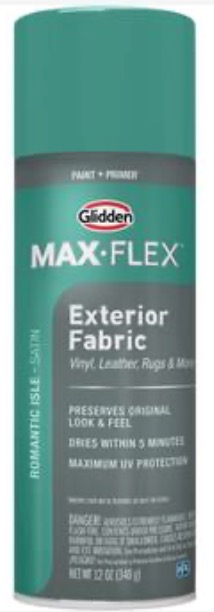 |
Glidden Max-Flex Exterior Fabric Spray Paint & Primer Satin, Color: Only Oatmeal, GMF2031-03/04/2025
Products in this Consumer Product Information Database (CPID) are classified based on their composition:
Substances: single chemicals
Preparations: products which contain chemicals that can be easily separated during normal use
Articles: products or product assemblies that do not contain chemicals that can be separated out from the product or assembly under normal or advertised use.
Classification: Preparation
Indicates country where product is sold.
Market: US/CanadaGlidden Max-Flex Exterior Fabric Spray Paint & Primer is an exterior paint + primer spray paint with revolutionary technology that provides maximized UV protection for exterior fabrics like vinyl, leather, rugs, and more. Glidden Max-Flex provides exceptional coverage while preserving the original look and feel of your item. The spray pattern provides a broad, smooth finish. It covers surfaces with fewer spray passes than a traditional conical shaped spray pattern and dries within 5 minutes with a flawless, durable finish.
Purpose of product.
Usage: Spray paintStructure such as solid, liquid, aerosol etc.
Form: aerosolDate when validity of Material Safety Data Sheet (MSDS) or Safety Data Sheet (SDS) was last verified.
Date verified: April 25, 202515885 West Sprague Road
Strongsville OH 44136
-
Chemical Composition/Ingredients
The GHS is an acronym for The Globally Harmonized System of Classification and Labelling of Chemicals. The GHS is a system for standardizing and harmonizing the classification and labelling of chemicals. Chemicals are associated with codes that define their health, physical and environmental hazards.This universal hazard communication system was developed to ensure that employers, employees and consumers are provided with adequate, practical, reliable and comprehensible information on the hazards of chemicals, so that they can take effective preventive and protective measure for their own health and safety.
Advanced
The GHS classifications for chemicals associated with products in this database may be viewed by selecting the "Advanced" button on the Chemical Ingredients tables. Since this is a work in progress, GHS classifications may not be shown for all chemical ingredients.-
-
Health Effects Information
Ingredients and Health Effects Information are taken from the manufacturer's product label and/or the Safety Data Sheet (SDS). Products are not tested and manufacturer's information presented here is not evaluated by DeLima Associates.
View Safety Data Sheet(SDS) Date that the Safety Data Sheet (SDS) was issued by manufacturer of a specific product.
SDS DATE :March 04, 2025 -
Warnings
Hazard Statements
Danger. Extremely flammable aerosol. Contains gas under pressure; may explode if heated. Causes skin irritation. Causes serious eye irritation. May cause drowsiness or dizziness. Suspected of causing cancer. Suspected of damaging fertility or the unborn child. May cause damage to organs through prolonged or repeated exposure. May form explosive peroxides. Hazardous reactions or instability may occur under certain conditions of storage or use. Prolonged or repeated contact may dry skin and cause irritation.
Precautionary Statements
General
Obtain special instructions before use. Do not handle until all safety precautions have been read and understood.
Prevention
Keep away from heat, hot surfaces, sparks, open flames and other ignition sources. No smoking. Do not spray on an open flame or other ignition source. Use only outdoors or in a well-ventilated area. Do not breathe dust or mist. Wash thoroughly after handling. Pressurized container: Do not pierce or burn, even after use. Contents under pressure. In a fire or if heated, a pressure increase will occur and the container may burst or explode. Do not puncture or incinerate. Keep away from heat and direct sunlight. Avoid contact with skin and clothing. Wash thoroughly after handling. Emits toxic fumes when heated.
Response
IF exposed or concerned: Get medical advice or attention.
IF INHALED: Remove person to fresh air and keep comfortable for breathing. Call a POISON CENTER or doctor if you feel unwell.
IF ON SKIN: Wash with plenty of water. If skin irritation occurs: Get medical advice or attention. Take off contaminated clothing and wash it before reuse.
IF IN EYES: Rinse cautiously with water for several minutes. Remove contact lenses, if present and easy to do. Continue rinsing. If eye irritation persists: Get medical advice or attention.
Photosensitive agents : In case of accidental eye contact, avoid direct exposure to the sun or other sources of UV light as severe irritation including burns may result. These reactions can be delayed – get medical attention if pain, irritation or blistering occurs after contact. In case of accidental skin contact, avoid direct exposure to the sun or other sources of UV light as severe irritation including burns may result. These reactions can be delayed – get medical attention if pain, irritation, rash or blistering occurs after contact.
Storage
Store locked up. Protect from sunlight. Do not expose to temperatures exceeding 50 °C/122 °F. Store in a well-ventilated place. Keep container tightly closed.
Disposal
Dispose of contents and container in accordance with all local, regional, national and international regulations. -
Acute health effects
From SDS:
Hazards Identification
Emergency Overview
Danger. Extremely flammable aerosol. Contains gas under pressure; may explode if heated. Causes skin irritation. Causes serious eye irritation. May cause drowsiness or dizziness. Suspected of causing cancer. Suspected of damaging fertility or the unborn child. May cause damage to organs through prolonged or repeated exposure. May form explosive peroxides. Hazardous reactions or instability may occur under certain conditions of storage or use. Prolonged or repeated contact may dry skin and cause irritation.
Potential Health Effects
Eye Contact: Causes serious eye irritation.
Skin Contact: Causes skin irritation. Defatting to the skin.
Inhalation: Can cause central nervous system (CNS) depression. May cause drowsiness or dizziness.
Ingestion: Can cause central nervous system (CNS) depression. -
Chronic health effects
From SDS:
Prolonged or repeated contact may dry skin and cause irritation. -
Carcinogenicity
Toluene, CAs No. 000108-88-3, IARC Group 3
4-methylpentan-2-one, CAS No. 000108-10-1, IARC Group 2B
Titanium dioxide, CAS No. 013463-67-7, IARC Group 2B
Ethylbenzene, CAS No. 000100-41-4, IARC Group 2B
-
Handling information
Put on appropriate personal protective equipment. Pressurized container: protect from sunlight and do not expose to temperatures exceeding 50°C. Do not pierce or burn, even after use. Avoid exposure - obtain special instructions before use. Avoid exposure during pregnancy. Do not handle until all safety precautions have been read and understood. Do not get in eyes or on skin or clothing. Do not breathe vapor or mist. Do not ingest. Avoid breathing gas. Use only with adequate ventilation. Wear appropriate respirator when ventilation is inadequate. Store and use away from heat, sparks, open flame or any other ignition source. Use explosion-proof electrical (ventilating, lighting and material handling) equipment. Use only non-sparking tools. Empty containers retain product residue and can be hazardous. Vapors may accumulate in low or confined areas or travel a considerable distance to a source of ignition and flash back. Vapors are heavier than air and may spread along floors. May form explosive peroxides. Keep away from combustible materials. Avoid shock and friction. Avoid all possible sources of ignition (spark or flame). If this material is part of a multiple component system, read the Safety Data Sheet(s) for the other component or components before blending as the resulting mixture may have the hazards of all of its parts. Eating, drinking and smoking should be prohibited in areas where this material is handled, stored and processed. Workers should wash hands and face before eating, drinking and smoking. Remove contaminated clothing and protective equipment before entering eating areas. Do not store above the following temperature: 50°C (122°F). Store in accordance with local regulations. Store away from direct sunlight in a dry, cool and well-ventilated area, away from incompatible materials and food and drink. Protect from sunlight. Store locked up. Eliminate all ignition sources. Use appropriate containment to avoid environmental contamination.
-
Disposal information
The generation of waste should be avoided or minimized wherever possible. Disposal of this product, solutions and any by-products should at all times comply with the requirements of environmental protection and waste disposal legislation and any regional local authority requirements. Dispose of surplus and non-recyclable products via a licensed waste disposal contractor. Waste should not be disposed of untreated to the sewer unless fully compliant with the requirements of all authorities with jurisdiction. Waste packaging should be recycled. Incineration or landfill should only be considered when recycling is not feasible. This material and its container must be disposed of in a safe way. Empty containers or liners may retain some product residues. Do not puncture or incinerate container.
-
First Aid
Eye Contact: Remove contact lenses, irrigate copiously with clean, fresh water, holding the eyelids apart for at least 10 minutes and seek immediate medical advice.
Skin Contact: Remove contaminated clothing and shoes. Wash skin thoroughly with soap and water or use recognized skin cleanser. Do NOT use solvents or thinners.
Inhalation: Remove to fresh air. Keep person warm and at rest. If not breathing, if breathing is irregular or if respiratory arrest occurs, provide artificial respiration or oxygen by trained personnel.
Ingestion: If swallowed, seek medical advice immediately and show this container or label. Keep person warm and at rest. Do NOT induce vomiting.
-
 CoC List
 UN Global Harmonization Classification


