What's in it?
Search Entire CPID Database
Enter Products, Manufacturers, Chemicals, Product Categories and Product Types
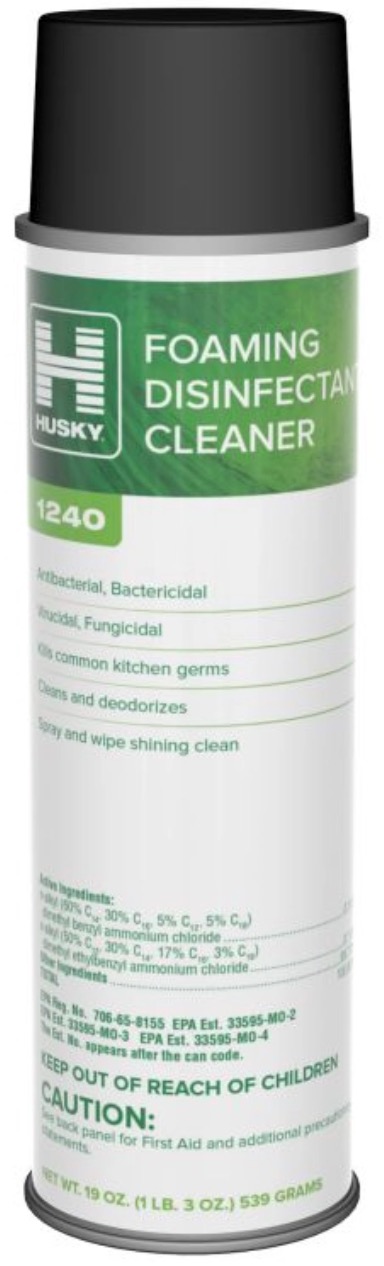 |
Canberra Husky Foaming Disinfectant Cleaner, 1240, Aerosol-01/02/2015
Products in this Consumer Product Information Database (CPID) are classified based on their composition:
Substances: single chemicals
Preparations: products which contain chemicals that can be easily separated during normal use
Articles: products or product assemblies that do not contain chemicals that can be separated out from the product or assembly under normal or advertised use.
Classification: Preparation
Indicates country where product is sold.
Market: US/CanadaCanberra Husky Foaming Disinfectant Cleaner is a quaternary ammonium disinfectant cleaner spray aerosol that cleans, disinfects, and deodorizes in one easy step. Excellent for use in healthcare settings due to its extensive disinfectant claims. EPA registered as a Broad Spectrum Disinfectant cleaner.
Purpose of product.
Usage: Surface sanitizerStructure such as solid, liquid, aerosol etc.
Form: aerosolDate when validity of Material Safety Data Sheet (MSDS) or Safety Data Sheet (SDS) was last verified.
Date verified: April 26, 20253610 Holland-Sylvania Road
Toledo OH 43615
-
Chemical Composition/Ingredients
The GHS is an acronym for The Globally Harmonized System of Classification and Labelling of Chemicals. The GHS is a system for standardizing and harmonizing the classification and labelling of chemicals. Chemicals are associated with codes that define their health, physical and environmental hazards.This universal hazard communication system was developed to ensure that employers, employees and consumers are provided with adequate, practical, reliable and comprehensible information on the hazards of chemicals, so that they can take effective preventive and protective measure for their own health and safety.
Advanced
The GHS classifications for chemicals associated with products in this database may be viewed by selecting the "Advanced" button on the Chemical Ingredients tables. Since this is a work in progress, GHS classifications may not be shown for all chemical ingredients.-
Primary Chemical Name is the standard name assigned to a chemical substance.
ChemicalChemical Abstracts Service Registry Number is a unique identifier for a chemical and its synonyms. CAS numbers identify the chemical, but not its concentration or specific mixture. CAS Registry Numbers are assigned by the Chemical Abstracts Service, a division of the American Chemical Society. For more information: www.cas.org
CAS No./ID
We have assigned "ID numbers" (with 6 leading zeros or nines, e.g., 000000-xx-x , 888888-xx-x) or 999999-xx-x) for blends and chemicals that do not have CAS numbers.Percent of chemical in preparation.
% Conc.Purpose served by this chemical
FunctionChemical of Concern (CoC)
Chemical of Concern(CoC)Phenylethyl alcohol 000060-12-8 -- Fragrance No Tetrasodium EDTA 000064-02-8 1.0-2.5 Chelating Agent No Isopropanol 000067-63-0 -- Solvent Yes  CoC List
Propane 000074-98-6 -- Propellant No A-Terpinyl Acetate 000080-26-2 -- Fragrance No Butane 000106-97-8 1.0-2.5 Propellant Yes CoC List
2-Butoxyethanol 000111-76-2 2.0-10.0 Solvent Yes CoC List
Benzyl Salicylate 000118-58-1 -- Fragrance Yes CoC List
Benzyl Benzoate 000120-51-4 -- Deodorizing Agent Yes CoC List
Benzyl acetate 000140-11-4 -- Fragrance No Sodium lauryl sulfate (SLS) 000151-21-3 -- Surfactant No Sodium hydroxide 001310-73-2 -- pH Adjuster Yes CoC List
Ammonium hydroxide 001336-21-6 -- pH Adjuster Yes CoC List
Trisodium nitrilotriacetate 005064-31-3 -- Corrosion Inhibitor No Cetamine oxide 007128-91-8 -- Surfactant No Water 007732-18-5 -- Solvent No n-Alkyl(C14, 60%; C16, 30%; C12, 5%; C18, 5%) dimethylbenzyl ammonium chloride 068391-01-5 -- Surfactant Yes CoC List
n-Alkyl (68% C12, 32% C14) dimethyl ethylbenzyl ammonium chloride 085409-23-0 -- Antimicrobial Active Yes CoC List
Chelating agent(s) 999999-50-6 -- Withheld as CBI No -
Health Effects Information
Ingredients and Health Effects Information are taken from the manufacturer's product label and/or the Safety Data Sheet (SDS). Products are not tested and manufacturer's information presented here is not evaluated by DeLima Associates.
View Safety Data Sheet(SDS) Date that the Safety Data Sheet (SDS) was issued by manufacturer of a specific product.
SDS DATE :January 02, 2015 -
Warnings
Hazard Statements
Danger. Extremely flammable aerosol. Causes serious eye irritation.
Precautionary Statements
General
Obtain special instructions before use.
Prevention
Keep away from heat/sparks/open flames/hot surfaces. No smoking. Do not spray on an open flame or other ignition source. Pressurized container: Do not pierce or burn, even after use. Do not breathe dust/fume/gas/mist/vapors/spray. Wear eye protection/face protection.
Response
IF SWALLOWED: Rinse mouth. Do NOT induce vomiting.
IF IN EYES: Rinse cautiously with water for several minutes. Remove contact lenses, if present and easy to do. Continue rinsing. If eye irritation persists, get medical advice/attention.
Storage
Protect from sunlight. Do not expose to temperatures exceeding 50 °C/122 °F.
Disposal
Dispose of contents/container to an approved disposal facility. -
Acute health effects
From SDS:
Hazards Identification
Emergency Overview
Danger. Extremely flammable aerosol. Causes serious eye irritation.
Potential Health Effects
Eye Contact: Causes serious eye irritation.
Skin Contact: 2-Butoxy ethanol may be absorbed through the skin in toxic amounts if contact is repeated and prolonged. These effects have not been observed in humans.
Inhalation: Prolonged inhalation may be harmful.
Ingestion: Expected to be a low ingestion hazard. -
Chronic health effects
From SDS:
Prolonged inhalation may be harmful. May be harmful if absorbed through skin. 2-Butoxyethanol may be absorbed through the skin in toxic amounts if contact is repeated or prolonged. Effects have not been observed in humans. -
Carcinogenicity
This product is not considered to be a carcinogen by IARC, ACGIH, NTP, or OSHA. -
Handling information
Pressurized container: Do not pierce or burn, even after use. Do not use if spray button is missing or defective. Do not spray on a naked flame or any other incandescent material. Do not smoke while using or until sprayed surface is thoroughly dry. Do not cut, weld, solder, drill, grind, or expose containers to heat, flame, sparks, or other sources of ignition. All equipment used when handling the product must be grounded. Do not get in eyes, on skin, or on clothing. Avoid prolonged exposure. Use only in well-ventilated areas. Wear appropriate personal protective equipment. Observe good industrial hygiene practices. Pressurized container. Protect from sunlight and do not expose to temperatures exceeding 50°C/122 °F. Do not puncture, incinerate or crush. Do not handle or store near an open flame, heat or other sources of ignition. This material can accumulate static charge which may cause spark and become an ignition source. Store away from incompatible materials.
-
Disposal information
Collect and reclaim or dispose in sealed containers at licensed waste disposal site. Contents under pressure. Do not puncture, incinerate or crush. Dispose of contents/container in accordance with local/regional/national /international regulations.Waste from residues/unused products: Dispose of in accordance with local regulations. Empty containers or liners may retain some product residues. This material and its container must be disposed of in a safe manner.Contaminated packaging: Empty containers should be taken to an approved waste handling site for recycling or disposal. Since emptied containers may retain product residue, follow label warnings even after container is emptied. -
First Aid
Eye Contact: Remove contact lenses, if present and easy to do. Continue rinsing. Irrigate copiously with clean, fresh water for at least 10 minutes, holding the eyelids apart.Skin Contact: Thaw frosted parts with lukewarm water. Do not rub affected area.Inhalation: If breathing is irregular or stopped, immediately seek medical assistance and start first aid actions. In case of respiratory tract irritation, consult a physician. Provide fresh air.Ingestion: Rinse mouth with water (only if the person is conscious). Do NOT induce vomiting.
-

 UN Global Harmonization Classification


