What's in it?
Search Entire CPID Database
Enter Products, Manufacturers, Chemicals, Product Categories and Product Types
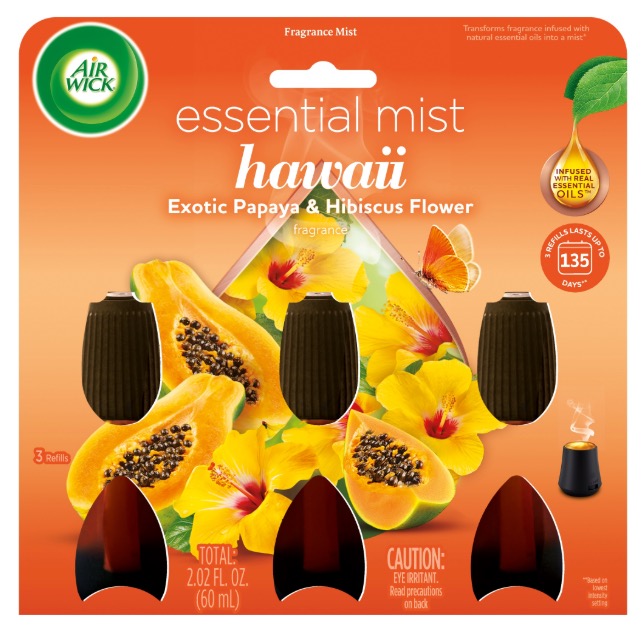 |
Air Wick Essential Mist, Hawaii Exotic Papaya & Hibiscus Flower-11/01/2023
Products in this Consumer Product Information Database (CPID) are classified based on their composition:
Substances: single chemicals
Preparations: products which contain chemicals that can be easily separated during normal use
Articles: products or product assemblies that do not contain chemicals that can be separated out from the product or assembly under normal or advertised use.
Classification: Preparation
Indicates country where product is sold.
Market: US/CanadaAir Wick Essential Mist diffusers transform fragrance infused with natural essential oils into a gentle mist that surrounds the home. Releases fragrance upwards and outwards, for better dispersion.
Purpose of product.
Usage: Room air freshenerStructure such as solid, liquid, aerosol etc.
Form: liquidDate when validity of Material Safety Data Sheet (MSDS) or Safety Data Sheet (SDS) was last verified.
Date verified: April 24, 2025Morris Corporate Center IV 399 Interpace Parkway
Parsippany NJ 07054
-
Chemical Composition/Ingredients
The GHS is an acronym for The Globally Harmonized System of Classification and Labelling of Chemicals. The GHS is a system for standardizing and harmonizing the classification and labelling of chemicals. Chemicals are associated with codes that define their health, physical and environmental hazards.This universal hazard communication system was developed to ensure that employers, employees and consumers are provided with adequate, practical, reliable and comprehensible information on the hazards of chemicals, so that they can take effective preventive and protective measure for their own health and safety.
Advanced
The GHS classifications for chemicals associated with products in this database may be viewed by selecting the "Advanced" button on the Chemical Ingredients tables. Since this is a work in progress, GHS classifications may not be shown for all chemical ingredients.-
Primary Chemical Name is the standard name assigned to a chemical substance.
ChemicalChemical Abstracts Service Registry Number is a unique identifier for a chemical and its synonyms. CAS numbers identify the chemical, but not its concentration or specific mixture. CAS Registry Numbers are assigned by the Chemical Abstracts Service, a division of the American Chemical Society. For more information: www.cas.org
CAS No./ID
We have assigned "ID numbers" (with 6 leading zeros or nines, e.g., 000000-xx-x , 888888-xx-x) or 999999-xx-x) for blends and chemicals that do not have CAS numbers.Percent of chemical in preparation.
% Conc.Purpose served by this chemical
FunctionChemical of Concern (CoC)
Chemical of Concern(CoC)C13-14 isoparaffin 064742-47-8 30.0-60.0 Solubilizer No C9-11 alkane/cycloalkane 064742-48-9 10.0-30.0 Solubilizer Yes  CoC List
Trimethylhexyl Acetate 058430-94-7 5.0-10.0 Solubilizer No Dipentene 000138-86-3 0.1-1.0 Fragrance No 2,4-Dimethyl-3-Cyclohexene Carboxaldehyde 068039-49-6 0.1-1.0 Fragrance No C13-16 Isoparaffin 068551-20-2 -- Solubilizer No Tripropylene glycol methyl ether 025498-49-1 -- Fragrance No C13-14 isoparaffin 064742-47-8 -- Fragrance No 2-T-Butylcyclohexyl Acetate 000088-41-5 -- Fragrance No Cyclohexanol, 2-(1,1-dimethylethyl)-, 1-acetate, (1R,2R)-rel- 020298-69-5 -- Fragrance No Trimethyl-Pentylcyclopentanone 065443-14-3 -- Fragrance No Dimethyl Heptenal 000106-72-9 -- Fragrance No Dimethylcyclohexylethoxy isobutylpropanoate 141773-73-1 -- Fragrance No 5-Ethyl-4-Hydroxy-2-Methylfuran-3(2h)-One 027538-09-6 -- Fragrance No 2-Methylpent-2-Enoic Acid 003142-72-1 -- Fragrance No 3-Hexenol 000928-96-1 -- Fragrance No Dimethyl-4-Isoheptenal Dimethyl Acetal 067674-46-8 -- Fragrance No Allyl Heptanoate 000142-19-8 -- Fragrance No Allyl Caproate 000123-68-2 -- Fragrance No Benzaldehyde 000100-52-7 -- Fragrance No Cinnamyl Acetate 000103-54-8 -- Fragrance No Citral 005392-40-5 -- Fragrance Yes CoC List
d-Limonene 005989-27-5 -- Fragrance Yes CoC List
Decanal 000112-31-2 -- Fragrance No Delta-Damascone 057378-68-4 -- Fragrance No 1,4-Cyclohexanedicarboxylic acid, 1,4-diethyl ester 072903-27-6 -- Fragrance No 2,6-Dimethyl-7-Octen-2-Ol 018479-58-8 -- Fragrance No Diphenyl Ether 000101-84-8 -- Fragrance No Ethyl 2,6,6-trimethylcyclohexa-1,3-ene-1-carboxylate 035044-59-8 -- Fragrance No Ethyl 2-Methylvalerate 039255-32-8 -- Fragrance No Ethyl Butyrate 000105-54-4 -- Fragrance No Ethyl Hexanoate 000123-66-0 -- Fragrance No Ethyl Hydroxypyrone 004940-11-8 -- Fragrance No Ethyl Octanoate 000106-32-1 -- Fragrance No Eucalyptol 000470-82-6 -- Fragrance No Gamma-Decalactone 000706-14-9 -- Fragrance No 2(3H)-Furanone, 5-heptyldihydro- 000104-67-6 -- Fragrance No Geranyl Propionate 000105-90-8 -- Fragrance No Hexenyl acetate 003681-71-8 -- Fragrance No Hexyl Butyrate 002639-63-6 -- Fragrance No Isoamyl Butyrate 000106-27-4 -- Fragrance No Menthol, L- 002216-51-5 -- Fragrance No Citrus Aurantifolia (Lime) Oil 008008-26-2 -- Fragrance No Citrus Nobilis (Mandarin Orange) Peel Oil 008008-31-9 -- Fragrance No Methyl Octine Carbonate 000111-80-8 -- Fragrance No Methyl Benzodioxepinone 028940-11-6 -- Fragrance No Methyl dihydrojasmonate 024851-98-7 -- -- No Nonanal 000124-19-6 -- Fragrance No Citrus Aurantium Amara Leaf/Twig Extract 068916-04-1 -- Fragrance No Citrus Aurantium Dulcis Oil (Orange oil) 008008-57-9 -- Fragrance No Terpenes and Terpenoids, sweet orange-oil 068647-72-3 -- Fragrance No P-Cymene 000099-87-6 -- Fragrance No Gamma-Terpinene 000099-85-4 -- Fragrance No Propanoic acid, 2-(1,1-dimethylpropoxy)-, propyl ester, (2S)- 319002-92-1 -- Fragrance No Menthone 000089-80-5 -- Fragrance No -
Health Effects Information
Ingredients and Health Effects Information are taken from the manufacturer's product label and/or the Safety Data Sheet (SDS). Products are not tested and manufacturer's information presented here is not evaluated by DeLima Associates.
View Safety Data Sheet(SDS) Date that the Safety Data Sheet (SDS) was issued by manufacturer of a specific product.
SDS DATE :November 01, 2023 Health Flammability Reactivity HMIS is the Hazardous Materials Identification System developed by the American Coatings Association and indicates the levels (“1” to “4”) of Health Hazard, Flammability Hazard and Physical Hazard associated with a specific product.
HMIS RATING3 1 0 -
Warnings
Hazard Statements
Danger. Combustible liquid. May be fatal if swallowed and enters airways. May cause an allergic skin reaction.
Precautionary statements.
General
Keep out of reach of children. If medical advice is needed, have product container or label at hand.
Prevention
Wear protective gloves, protective clothing and eye or face protection. Keep away from flames and hot surfaces. No smoking. Avoid breathing vapor. Contaminated work clothing must not be allowed out of the workplace.
Response
IF SWALLOWED: Immediately call a POISON CENTER or doctor. Do NOT induce vomiting. Wash contaminated clothing before reuse.
IF ON SKIN: Wash with plenty of water. If skin irritation or rash occurs: Get medical advice or attention.
Storage
Store locked up. Store in a well-ventilated place. Keep cool.
Disposal
Dispose of contents and container in accordance with all local, regional, national and international regulations. -
Acute health effects
From SDS:
Hazards Identification
Emergency Overview
Danger. Combustible liquid. May be fatal if swallowed and enters airways. May cause an allergic skin reaction.
Potential Health Effects
Eye Contact: No known significant effects or critical hazards.
Skin Contact: May cause an allergic skin reaction.
Inhalation: No known significant effects or critical hazards.
Ingestion: May be fatal if swallowed and enters airways. -
Chronic health effects
From SDS:
No information. -
Carcinogenicity
No known significant effects or critical hazards.
-
Handling information
Put on appropriate personal protective equipment. Do not ingest. Avoid contact with eyes, skin and clothing. Avoid breathing vapor or mist. Avoid release to the environment. Use only with adequate ventilation. Wear appropriate respirator when ventilation is inadequate. Do not enter storage areas and confined spaces unless adequately ventilated. Keep in the original container or an approved alternative made from a compatible material, kept tightly closed when not in use. Store and use away from heat, sparks, open flame or any other ignition source. Use explosion-proof electrical (ventilating, lighting and material handling) equipment. Use only non-sparking tools. Empty containers retain product residue and can be hazardous. Do not reuse container.
Store in accordance with local regulations. Store in a segregated and approved area. Store in original container protected from direct sunlight in a dry, cool and well-ventilated area, away from incompatible materials and food and drink. Eliminate all ignition sources. Separate from oxidizing materials. Keep container tightly closed and sealed until ready for use. Containers that have been opened must be carefully resealed and kept upright to prevent leakage. Do not store in unlabeled containers. Use appropriate containment to avoid environmental contamination. -
Disposal information
The generation of waste should be avoided or minimized wherever possible. Disposal of this product, solutions and any by-products should at all times comply with the requirements of environmental protection and waste disposal legislation and any regional local authority requirements. Dispose of surplus and non-recyclable products via a licensed waste disposal contractor. Waste should not be disposed of untreated to the sewer unless fully compliant with the requirements of all authorities with jurisdiction. Waste packaging should be recycled. Incineration or landfill should only be considered when recycling is not feasible. This material and its container must be disposed of in a safe way. Care should be taken when handling emptied containers that have not been cleaned or rinsed out. Empty containers or liners may retain some product residues. Vapor from product residues may create a highly flammable or explosive atmosphere inside the container. Do not cut, weld or grind used containers unless they have been cleaned thoroughly internally. Avoid dispersal of spilled material and runoff and contact with soil, waterways, drains and sewers.
-
First Aid
Eye Contact: Immediately flush eyes with plenty of water, occasionally lifting the upper and lower eyelids. Check for and remove any contact lenses. Continue to rinse for at least 10 minutes. Get medical attention if irritation occurs.Skin Contact: Wash with plenty of soap and water. Remove contaminated clothing and shoes. Wash contaminated clothing thoroughly with water before removing it, or wear gloves. Continue to rinse for at least 10 minutes. Get medical attention. In the event of any complaints or symptoms, avoid further exposure. Wash clothing before reuse. Clean shoes thoroughly before reuse.Inhalation: Remove victim to fresh air and keep at rest in a position comfortable for breathing. If not breathing, if breathing is irregular or if respiratory arrest occurs, provide artificial respiration or oxygen by trained personnel. It may be dangerous to the person providing aid to give mouth-to-mouth resuscitation. Get medical attention if adverse health effects persist or are severe. If unconscious, place in recovery position and get medical attention immediately. Maintain an open airway. Loosen tight clothing such as a collar, tie, belt or waistband.Ingestion: Get medical attention immediately. Call a poison center or physician. Wash out mouth with water. Remove dentures if any. If material has been swallowed and the exposed person is conscious, give small quantities of water to drink. Stop if the exposed person feels sick as vomiting may be dangerous. Aspiration hazard if swallowed. Can enter lungs and cause damage. Do not induce vomiting. If vomiting occurs, the head should be kept low so that vomit does not enter the lungs. Never give anything by mouth to an unconscious person. If unconscious, place in recovery position and get medical attention immediately. Maintain an open airway. Loosen tight clothing such as a collar, tie, belt or waistband.
-

 UN Global Harmonization Classification


