What's in it?
Search Entire CPID Database
Enter Products, Manufacturers, Chemicals, Product Categories and Product Types
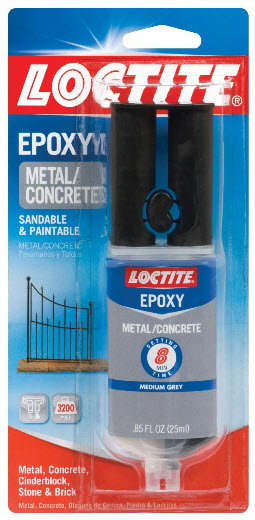 |
Loctite Epoxy Metal-Concrete-12/22/2014
Products in this Consumer Product Information Database (CPID) are classified based on their composition:
Substances: single chemicals
Preparations: products which contain chemicals that can be easily separated during normal use
Articles: products or product assemblies that do not contain chemicals that can be separated out from the product or assembly under normal or advertised use.
Classification: Preparation
Indicates country where product is sold.
Market: US/CanadaLoctite Epoxy Metal/Concrete is a two-part system consisting of an epoxy resin and a hardener. The convenient syringe dispenses equal amounts of each component every time. When mixed in equal volumes, resin and hardener react to produce a tough, rigid, high strength bond in 5 to 12 minutes. It is used as an adhesive for repairing, filling and rebuilding all metal and concrete surfaces. Loctite Epoxy Metal/Concrete does not conduct electricity which is ideal for sealing electrical components. It cures to a metallic gray finish and can be easily sanded or machined. It does not shrink and is resistant to water and most common solvents. Bonding metal and concrete as well as glass, ceramic and wood. Use for repairing machinery, appliances, tools, lawnmowers, automotive components, pipes, imbedding bolts and screws into metals, concrete or stone and sealing electrical components against moisture and vibration.
Purpose of product.
Usage: Epoxy AdhesiveStructure such as solid, liquid, aerosol etc.
Form: liquidDate when validity of Material Safety Data Sheet (MSDS) or Safety Data Sheet (SDS) was last verified.
Date verified: April 25, 2025200 Elm Street
Stamford, CT CT 06902
-
Chemical Composition/Ingredients
The GHS is an acronym for The Globally Harmonized System of Classification and Labelling of Chemicals. The GHS is a system for standardizing and harmonizing the classification and labelling of chemicals. Chemicals are associated with codes that define their health, physical and environmental hazards.This universal hazard communication system was developed to ensure that employers, employees and consumers are provided with adequate, practical, reliable and comprehensible information on the hazards of chemicals, so that they can take effective preventive and protective measure for their own health and safety.
Advanced
The GHS classifications for chemicals associated with products in this database may be viewed by selecting the "Advanced" button on the Chemical Ingredients tables. Since this is a work in progress, GHS classifications may not be shown for all chemical ingredients.-
-
Health Effects Information
Ingredients and Health Effects Information are taken from the manufacturer's product label and/or the Safety Data Sheet (SDS). Products are not tested and manufacturer's information presented here is not evaluated by DeLima Associates.
View Safety Data Sheet(SDS) Date that the Safety Data Sheet (SDS) was issued by manufacturer of a specific product.
SDS DATE :December 22, 2014 Health Flammability Reactivity HMIS is the Hazardous Materials Identification System developed by the American Coatings Association and indicates the levels (“1” to “4”) of Health Hazard, Flammability Hazard and Physical Hazard associated with a specific product.
HMIS RATING3 1 0 -
V.O.C Information
Volatile Organic Compounds %/Wt. With Solvent : 0
-
Warnings
DANGER: Hardener contains quartz silica, polymercaptan, phenol, quartz silica and amine curing agents. Resin contains epoxy resin, aluminum and quartz silica. Do not get in eyes or on skin. Do not breathe vapors. KEEP OUT OF THE REACH OF CHILDREN
-
Acute health effects
From MSDS:
Hazards Identification
Emergency Overview: Resin Component: Abrasion could release respirable particles of silica quartz, a cancer hazard by inhalation. Normal use of this product causes no such release. Causes skin irritation. May cause an allergic skin reaction. Causes serious eye irritation. Hardener Component: Causes eye, skin and respiratory tract burns. May be harmful if swallowed or absorbed through skin.
Primary Routes of Entry: Skin, Inhalation, Eyes, Ingestion
Potential Health Effects of Resin Component:-
Eye Contact: Causes eye irritation. Direct contact may cause temporary redness and discomfort.
Skin Contact: May cause allergic skin reaction. Causes skin irritation. Redness.
Inhalation: May cause respiratory tract irritation. Coughing.
Ingestion: Not expected to be harmful by ingestion.
Potential Health Effects of Hardener Component:-
Eye Contact: Burns. Severe eye irritation. Redness. Tissue damage.
Skin Contact: May cause skin burns. May be harmful if absorbed through skin. Rash. Redness. Tissue damage.
Inhalation: Respiratory tract burns. May cause respiratory tract irritation. May cause irritation to nose and throat. Lung damage.
Ingestion: May be harmful if swallowed. May cause burns of mouth and throat if swallowed.
Existing conditions aggravated by exposure: Eye, skin, and respiratory disorders. Skin allergies.
-
Chronic health effects
From MSDS:
No information provided. -
Carcinogenicity
Listed by IARC as Group 1: Quartz
Listed by NTP: Quartz -
Handling information
Resin
Keep container closed. Avoid contact with eyes, skin and clothing. Avoid breathing vapors or mists of this product. Wash thoroughly after handling. Use only with adequate ventilation. Keep in a cool, well ventilated area away from heat, sparks and open flame. Keep container tightly closed until ready for use.
Hardener
Keep away from heat, spark and flame. Do not breathe gas/fumes/vapor/spray. Keep container closed. Avoid contact with eyes, skin and clothing. Wash thoroughly after handling. For safe storage, store at or below 37.8 deg C (100 deg F). Store in original container until ready to use. Keep in a cool, well ventilated area away from heat, sparks and open flame. Keep container tightly closed until ready for use. -
Disposal information
Follow all local, state, federal and provincial regulations for disposal.
-
California Prop. 65 Warning
This product contains a chemical known in the State of California to cause cancer.
This product contains a chemical known to the State of California to cause birth defects or other reproductive harm. -
First Aid
First Aid for exposure to Resin Component
Eye Contact: Immediately flush eyes with plenty of water for at least 15 minutes. Get medical attention.
Skin Contact: Immediately flush skin with plenty of water (using soap, if available). Remove contaminated clothing and footwear. Wash clothing before reuse. Get medical attention.
Inhalation: Move to fresh air. If not breathing, give artificial respiration. If breathing is difficult, give oxygen. Get medical attention
Ingestion: Do not induce vomiting. Never give anything by mouth to an unconscious person. Get medical attention.
First Aid for exposure to Hardener Component
Eye Contact: Immediately flush eyes with plenty of water for at least 15 minutes. Get medical attention.
Skin Contact: Immediately flush skin with plenty of water (using soap, if available). Remove contaminated clothing and footwear. Wash clothing before reuse. Thoroughly clean shoes before reuse. If symptoms develop and persist, get medical attention.
Inhalation: Move to fresh air. If not breathing, give artificial respiration. If breathing is difficult, give oxygen. Get medical attention.
Ingestion: Do not induce vomiting. Keep individual calm. Never give anything by mouth to an unconscious person. Get medical attention.
-
 CoC List
 UN Global Harmonization Classification


